

17 Curtain Room Divider Ideas for Studio Apartments
Curtain room divider ideas are the studio renter’s best friend. You get a bedroom, a dressing area, or a hidden kitchen without building a single wall. Anyone who has lived in a studio knows the core frustration: your bed is visible from the front door, your desk stares at you during dinner, and guests see everything, including the drying rack. Curtains solve all of that for less money than almost any other divider. They cost a fraction of what bookshelves or folding screens cost, they eat up zero floor space, and most of them come down in minutes when you move out. The trick is picking the right curtain, the right hardware, and the right spot. These curtain room divider ideas cover all three. You will find the best mounting methods for renters, which fabrics actually work, and how to divide every zone of a studio, from the bed to the kitchen to the work corner, so one room finally feels like several.
1. Mount a Ceiling Curtain Track
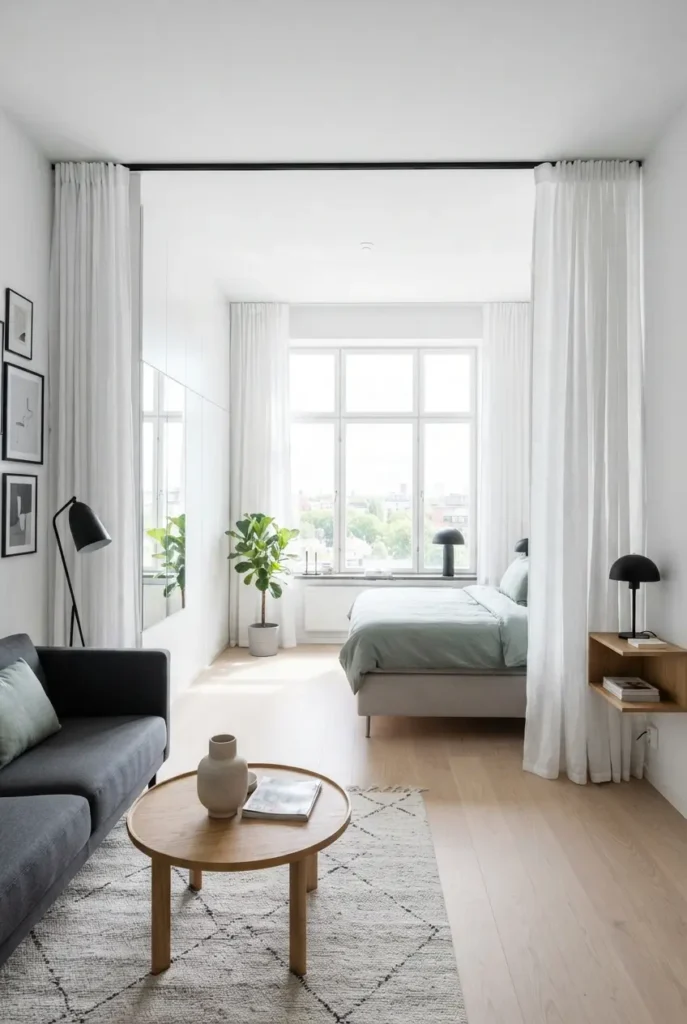
A ceiling-mounted track is the gold standard of curtain room divider ideas. It holds heavier fabric without sagging, it runs straight or around corners, and the curtain glides smoothly instead of catching like it does on a rod. A basic straight track costs 25 to 40 dollars, while a flexible curved track that bends around corners runs 40 to 70 dollars. You will need to drill into the ceiling, so check with your landlord first and locate a stud or use proper ceiling anchors, because a track full of wet-weight linen pulling on drywall alone will fail. Mount the track as close to the ceiling as possible and let the curtain fall all the way to the floor. That full height is what makes it look built in rather than improvised. For curtain fullness, buy panels whose combined width is 1.5 to 2 times the track length. Flat panels pulled tight look cheap; gathered fabric looks deliberate. This curtain track guide from Apartment Therapy shows how renters pull it off without wrecking the ceiling.
2. Use a Tension Rod (No Drilling)

If drilling is off the table, a tension rod is your answer. It wedges between two walls with pressure alone, so there are no holes and no damage. The catch is weight: most tension rods hold 5 to 10 pounds, which means light fabric like sheers or thin cotton only. Measure your span carefully and buy a rod rated for a bit more than you need, because a rod extended to its absolute maximum will slip over time. Look for rods with rubber end caps, which grip better and protect your paint. Get the measuring right and a tension rod is one of the easiest curtain room divider ideas to install in an afternoon. Push the rod as close to the ceiling as you can to close the gap at the top, since a visible gap ruins the illusion of a wall. If your span is wider than 6 feet, plan on a center support or accept a slight bow in the middle. For more no-drill options, these renter-friendly room divider ideas cover what works when the landlord says no.
3. Go Sheer for Daylight

Sheer curtains divide the room without dividing the light. From the living area you see a soft white veil instead of a bed, and the sleeping zone still gets every ray of daylight. This is the move when your studio has one good window and you refuse to give it up. Hang sheers on a ceiling track or tension rod and keep them floor length so they read as a real wall, not a window treatment in the wrong place. If one layer feels too see-through, hang two sheer panels on the same rod. The double layer blurs shapes noticeably while barely dimming the room. White or ivory sheers work in every color scheme and they cost almost nothing, often under 15 dollars a pair. Among curtain room divider ideas, sheers are the best choice when you refuse to lose natural light. Wash them twice a year because sheers show dust fast in a small space.
Pro Tip:
Buy sheers a few inches longer than you need and let them puddle slightly on the floor. That extra fabric is what makes cheap sheers look expensive.
4. Go Blackout for the Bed Zone

If you work nights or just sleep light, sheer will not cut it. Blackout curtains turn an open corner into a genuinely dark sleeping zone. They also muffle a little sound, though no curtain will make a studio silent, and the thermal lining on most blackout panels adds a bit of insulation against drafty windows. Pick a dark color like charcoal or navy so light does not glow through the fabric, and overlap two panels in the middle by 4 to 6 inches so there is no light leak where they meet. A ceiling track holds blackout weight far better than a tension rod, since blackout panels are among the heaviest curtain fabrics. Choose grommet tops for the smoothest glide on a rod, or back-tab tops for a cleaner look on a track. For anyone serious about sleep, blackout panels are the hardest-working curtain room divider ideas on this list. Your sleep is worth the one-time drilling conversation with the landlord. If you share the studio with a partner, blackout curtains are non-negotiable, and these studio apartment ideas for couples cover more ways to share one room peacefully.
5. Wrap an L-Shaped Corner
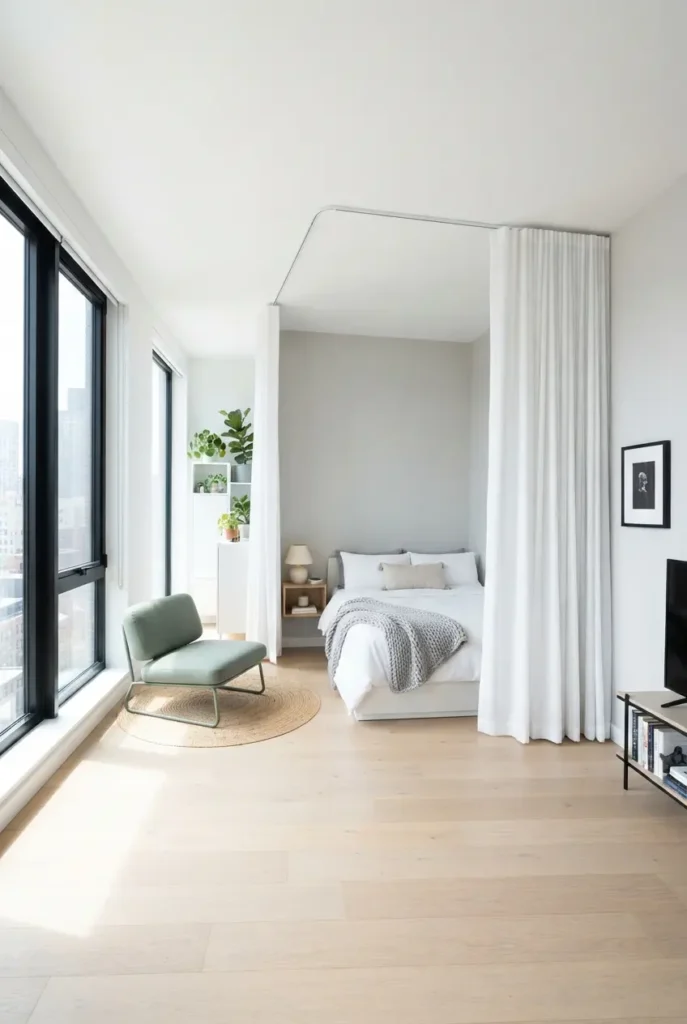
Most studio beds sit in a corner, which means you only need two sides of curtain to box it in. Run one track along each open side of the corner, or use a single curved track that bends around both. The curved track costs more but gives you one continuous curtain with no gap at the bend, which looks far cleaner. When the curtains close, the bed disappears completely. When they open, the room feels big again. This L-shape is one of the most space-efficient curtain room divider ideas because it uses walls you already have as two sides of the “room.” Measure each side of the corner separately and remember the fullness rule: each side needs panels totaling 1.5 to 2 times its track length. It works especially well in square studios where the bed would otherwise stare at the front door.
6. Layer Sheer Over Solid

Why choose between light and privacy when you can have both? Hang a sheer panel and a solid panel on a double track or two parallel rods. Keep the sheer closed all day for soft light and a sense of separation, then pull the solid panel across at night for full privacy. Mount the two tracks 2 to 3 inches apart so the layers do not snag on each other. Put the sheer on the track facing the window side and the solid on the room side, so the pretty layer is the one you see most. It is the same trick hotels use, and it makes the divider feel intentional rather than improvised, which is the goal of all good curtain room divider ideas. This layered look also adds texture, which matters in a small room where every surface is visible. Yes, it doubles your fabric cost, but two budget panels still cost less than one folding screen. If you like this hotel-style thinking, these cozy studio ideas use the same layered approach for warmth.
7. Try a Beaded Curtain

Beaded curtains will not give you full privacy, but they are perfect for doorways and partial separation. They mark a boundary, they move beautifully when you walk through, and they add a boho texture that fabric cannot. Hang one between the living area and a reading nook, or in front of an open closet. They cost very little, usually 15 to 30 dollars, and they need only a small tension rod or a few hooks. Measure your opening and buy a beaded curtain a few inches wider so it hangs full rather than stretched flat. Two honest warnings: beads click when they move, so skip them right next to the bed if you are a light sleeper, and they collect dust, so take them down and shake them out every few months. As far as curtain room divider ideas go, this is the cheapest way to mark a boundary. Just know what you are getting: a vibe divider, not a privacy divider.
8. Hang Floor-to-Ceiling Linen Panels

Linen is the modern curtain fabric. It has a natural texture, it hangs with soft folds instead of stiff pleats, and it looks good from both sides, which matters when both sides are your living room. Among curtain room divider ideas, floor-to-ceiling linen panels read the most high end for the least money. Choose a neutral like oatmeal, flax, or warm white, and steam out the wrinkles once after hanging. Pre-wash linen panels before hemming if you plan to cut them, because linen can shrink a few percent on the first wash. For fullness, follow the 2-times rule here: linen looks best generously gathered, so buy panels totaling twice your track width. Affordable linen-look panels are widely available, but check the fabric content: a linen-cotton blend wrinkles less than pure linen and costs less too.
Pro Tip:
Sew or iron a row of curtain weights into the bottom hem. Weighted linen hangs straight instead of billowing every time the AC kicks on.
9. Divide with Patterned Curtains

A patterned curtain does two jobs: it divides the room and it acts as art. A bold stripe, a block print, or a large-scale floral turns a blank divider into the focal point of the studio. This works best when the rest of the room is fairly calm, so the curtain gets to be the star. Keep the pattern large rather than fussy, because small prints turn to visual noise at curtain scale. As a rule of thumb, look for a pattern repeat of 12 inches or more. One patterned divider is plenty. Two competing patterns in one room will fight each other. Pair your print with solids pulled from these studio apartment color schemes and the whole room will hang together. If the pattern has a clear top and bottom, double-check the panel orientation before you hang, because an upside-down floral is surprisingly hard to unsee.
10. Curtain Off the Closet Nook
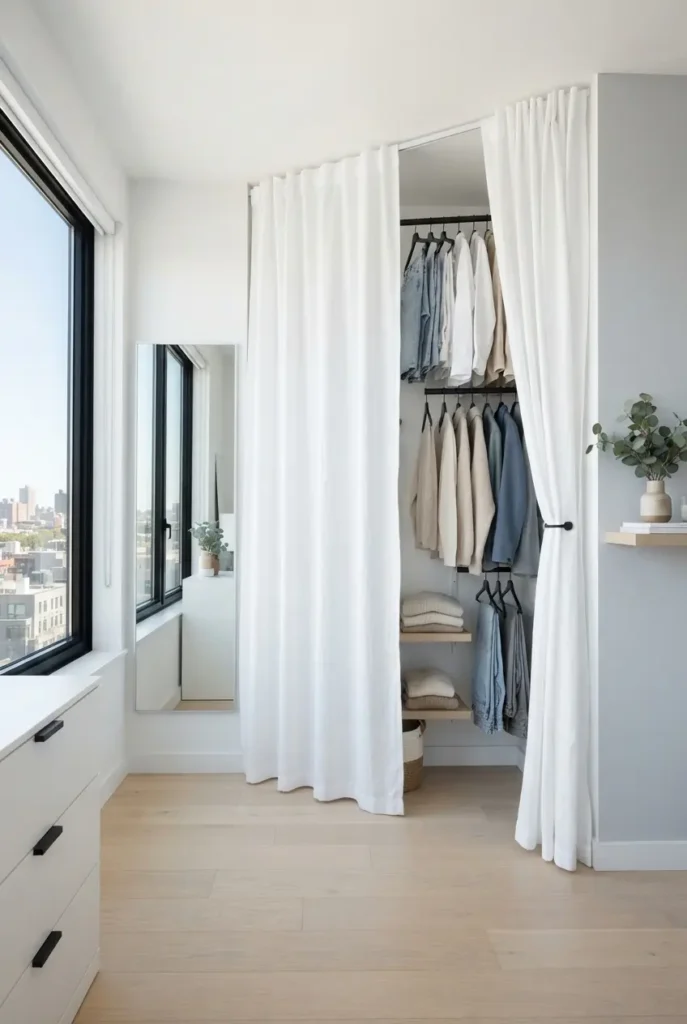
Open closets and storage nooks are practical but ugly. A curtain across the front hides the mess and gives you a clean wall of fabric instead. This is one of the simplest curtain room divider ideas because the span is small: one tension rod and one panel usually does it, often for under 25 dollars total. Decide between an inside mount, where the rod sits within the nook frame for a flush look, and an outside mount, which covers the frame edges and hides more. Match the curtain to your wall color and the storage visually disappears. It also keeps dust off your clothes, which is a real bonus in a studio where everything shares the same air. For more ways to make storage disappear, these organization ideas are built for studios with no spare inch.
11. Create a Dressing Corner

Every studio needs a spot to change without an audience, especially when guests stay over. Pick a corner, mount a short curtain track or tension rod across it, and hang one solid panel. A 3-by-3-foot corner is enough: inside you need only a mirror and a small stool or ottoman. Add a battery-powered puck light on the wall inside the corner, because dressing corners are always dark and you will want to see what you are doing. It takes up about nine square feet and it solves the most awkward part of studio living. A dressing corner also gives guests a private spot to change, which makes hosting overnight visitors far less uncomfortable for everyone. Choose an opaque fabric here, not a sheer: this is one divider where see-through defeats the purpose.
12. Add Tie-Backs for Flexible Privacy

The best dividers are the ones you can open. Sew or clip tie-backs onto your curtain panels so you can pull them to the sides during the day and close them at night. Magnetic tie-backs are the easiest option: no sewing, no hooks, and they work on any fabric thick enough for the magnets to grip through. Place tie-backs about two-thirds of the way down the panel for the most flattering gathered shape. This single detail changes a curtain from a permanent wall into a flexible zone. Open curtains make the studio feel twice as big when you are alone. Closed curtains give you privacy when you need it. Brass or rope tie-backs look intentional, while the curtain just shoved to one side looks like you gave up halfway.
13. Build a Freestanding Curtain Frame
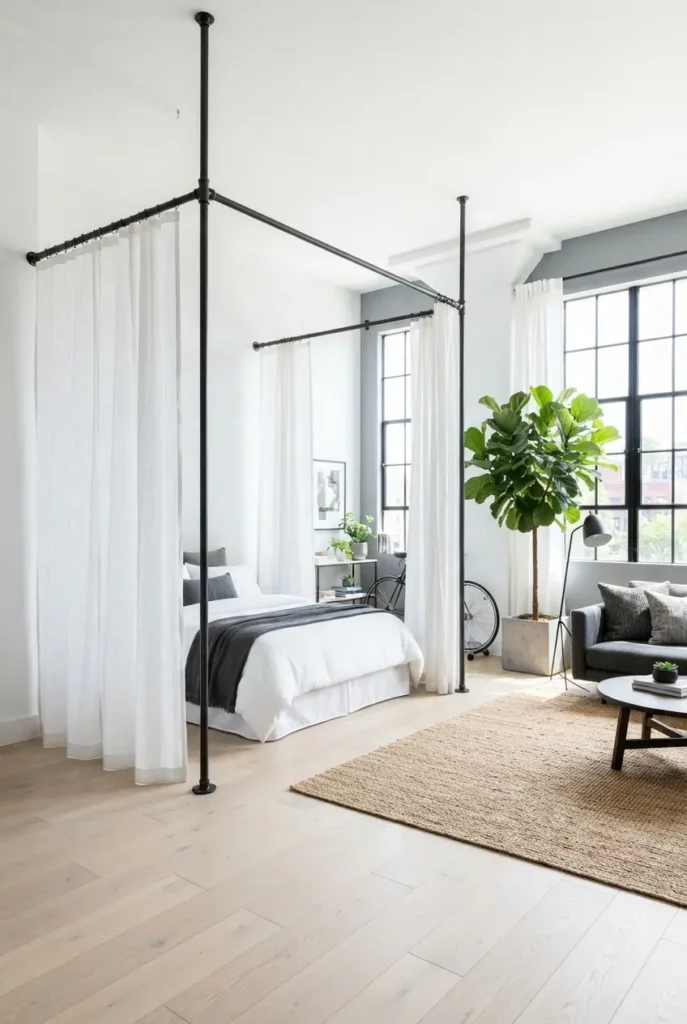
No walls in the right place? No problem. Build a simple freestanding frame from copper pipe, conduit, or a heavy-duty garment rack, and hang curtains from it. For a pipe build, 3/4-inch copper pipe with elbow joints and floor flanges makes a sturdy frame for about 60 to 80 dollars in parts. The frame stands on its own, so you need zero drilling and zero wall contact. This is one of the most flexible curtain room divider ideas because you can move the whole divider when you rearrange. Weight the base with sandbags or hang the bottom hem slightly long so it does not tip. A pipe frame with linen curtains looks industrial and intentional, not improvised. The whole build usually costs less than the options in these budget decor ideas.
Pro Tip:
Use floor-flange feet on a pipe frame and slide furniture against the base. The furniture hides the feet and anchors the whole thing.
14. Hide the Kitchen with a Curtain

Studio kitchens are part of the living room whether you like it or not. A curtain across the kitchen opening lets you hide dirty dishes, drying racks, and cooking mess the moment guests arrive. Mount a track or rod at the kitchen entry and keep the curtain tied back while you cook, then pull it closed when people come over. Choose a washable fabric because kitchen grease travels through the air and settles on everything. Polyester blends or outdoor fabrics wash best; pure linen near a stove will absorb odors. For a softer look, try a cafe-style half curtain that hides the counter mess while leaving the upper cabinets visible. This five-second reset is faster than cleaning the whole kitchen, and honestly, it is the real reason most studio renters fall in love with curtain dividers.
15. Hang a Macrame Divider

Macrame dividers are curtains made of knotted rope, and they bring a texture nothing else can match. Light passes through the knots, so the room stays bright, but the dense knotting still reads as a clear boundary. Among curtain room divider ideas, macrame is the most decorative and the least private, so use it between the living area and a plant corner or reading nook rather than around the bed. Buy one a few inches wider than your opening so the knots sit full rather than stretched. They are lightweight and hang from a single wooden dowel on two hooks. A large handmade macrame piece costs 50 to 120 dollars, far less than a folding screen, and a simple DIY version needs only cotton cord and a weekend. Dust it with a hair dryer on cool every few months, because knotted rope traps dust in every crevice.
16. Curtain the Work-From-Home Corner

Remote work in a studio means your desk stares at you all evening. A curtain across the work corner lets you close the office at 6pm, literally. Pull it shut when the workday ends and the whole apartment exhales. This mental boundary matters more than people expect: seeing your laptop from the sofa keeps your brain at work, and studies on remote workers keep finding that a physical end-of-day ritual improves rest. Make closing the curtain that ritual. A simple solid panel on a tension rod does the job, and a calming color like sage or soft blue reinforces the off-duty signal. As a bonus, the curtain hides cable clutter and monitors, which are the two ugliest things in any living room. If your desk setup is part of a bigger layout puzzle, this 200 sq ft layout guide shows where a work zone fits without eating the room.
17. Use Outdoor Curtains Indoors

Outdoor curtains are made to hang straight in wind, which means they hang beautifully still indoors. The fabric is heavier than indoor sheers, it resists wrinkles, and most of it is washable and fade resistant. Look for solution-dyed acrylic fabrics, the same family as Sunbrella-type materials, which hold color for years even in direct sun. That makes outdoor panels some of the most practical curtain room divider ideas for high-traffic studios, and a real advantage if your divider sits in front of a sunny window where regular fabric would fade. They come in far better colors than they used to, so skip the old beige gazebo look and pick a rich solid or subtle stripe. Most outdoor panels come with grommet tops, which glide easily and suit the heavier fabric. Your divider will look crisp for years instead of going limp in six months.
Pro Tip:
Whatever fabric you choose, buy curtains that look good from both sides. In a studio, the back of your divider is someone’s view.
Conclution
Curtain room divider ideas work because they give you walls on demand, at a price no other divider can touch. Start with the zone that bothers you most, usually the bed, and hang one curtain before you plan the rest. Live with it for a week. Notice when you open it and when you close it, then decide whether you need a second divider or whether one was enough. Most studios need only one or two curtains to feel like a real apartment with real rooms. Measure twice, mount at the ceiling, let the fabric touch the floor, and your one room will finally feel like several. For more ways to carve up one room, browse all our room divider ideas.