
Apartment Bike Storage Ideas That Keep a Studio Liveable
This post may contain affiliate links. If you buy through them, we may earn a small commission at no extra cost to you.
A bike parked in the middle of a studio, right between the bed and the kitchen, is the biggest reason a small apartment feels cluttered. If you have been searching for apartment bike storage ideas that do not involve drilling into a wall you do not own, the real problem usually is not the bike. It is the lack of one fixed spot for it to live.
Good apartment bike storage ideas all share the same shape, even when the exact stand or rack changes. The fix is simple once you see it. Give the bike a set spot by the door, keep the path from bed to exit clear, contain the dirt it tracks in, and keep any e-bike charging off that same walking path. Do that and riding stays easy, and the room stays liveable. Every idea below builds toward that one system.
1. Park It By The Door, Not In The Middle
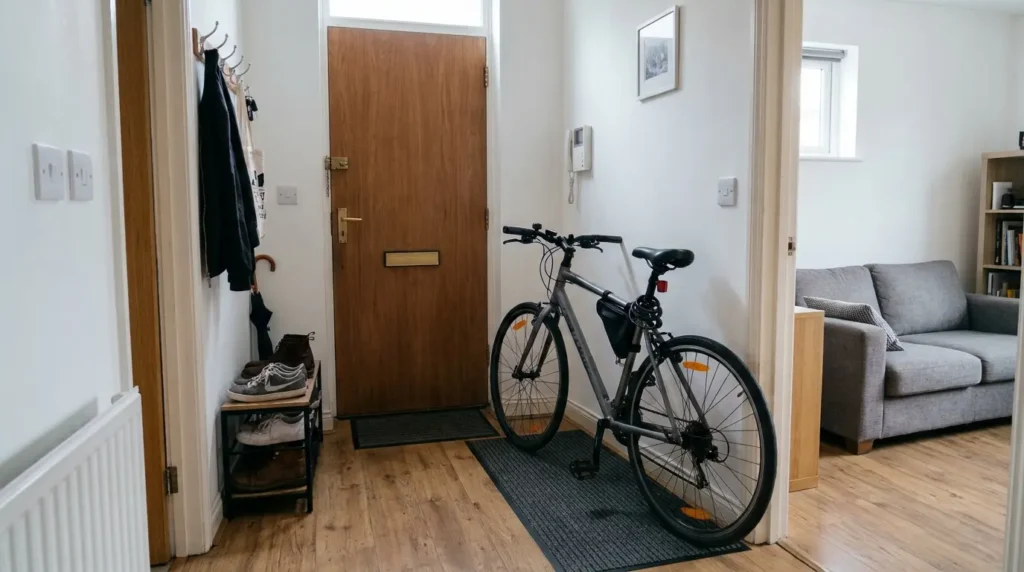
You get home tired, maybe a little wet, and the bike ends up wherever you drop it. That one habit is what makes a studio feel like a bike shop.
Pick the corner closest to your apartment door. Set the bike facing out, with the handlebars turned parallel to the wall so it sits flat instead of sticking into the room. Put a rubber mat under both wheels to catch dirt and water, and add a small bin on the same shelf for your helmet and lock. A towel hook nearby lets you wipe the tires before you roll in.
Measure the path from your bed to the door first. You want at least 30 inches clear at all times, even with the bike parked. This setup costs very little, usually just one mat and one bin, and a renter can move it out in minutes with nothing to patch. Out of every option in this list of apartment bike storage ideas, this one is the cheapest to start with tonight, before you buy anything else. The one thing to avoid: parking in the middle of the room, even for a single night. That one exception is how the habit breaks.
2. Tension Pole Vertical Parking For Two Bikes
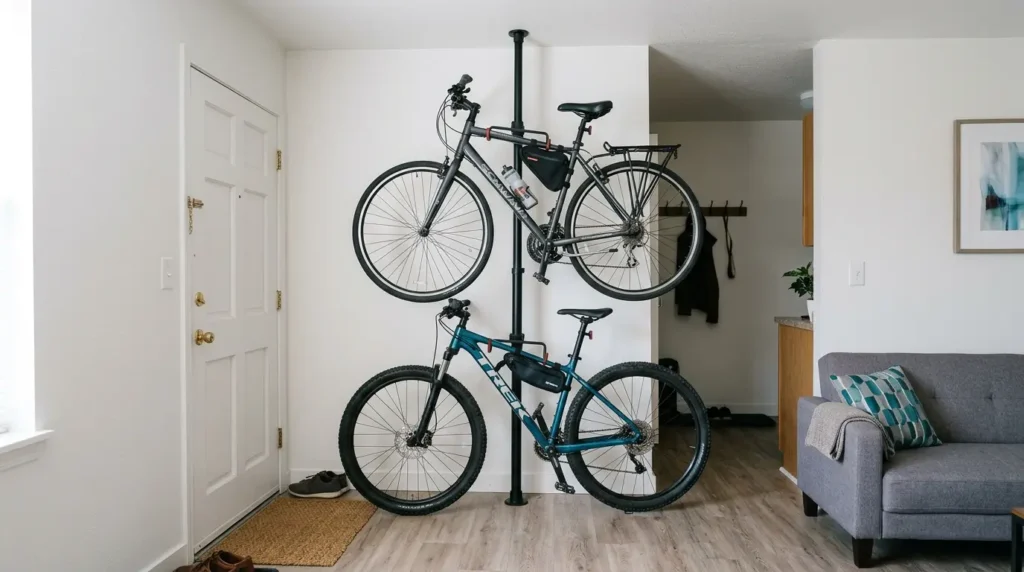
Two bikes and no floor space left is a common studio problem, especially for couples. A tension pole solves it by using height instead of floor area.
These poles run floor to ceiling and hold themselves in place with compression caps, no screws needed. Adjustable arms let you hang one bike above the other, and the heavier bike should always go on the lower arm for stability. Measure your ceiling height twice, including the thickness of any carpet or rug pile, since even half an inch throws off the fit. Check the pole weight rating carefully, since many models hold up to 45 kilograms or more, and two bikes together can exceed that rating.
Renters can take these down without leaving a mark, since the pressure is light compression against the ceiling and floor, and most landlords treat a tension pole as furniture rather than a fixture. Cost sits in the mid range. Skip this option on a sloped or very low ceiling, and recheck the torque on the compression cap after the first day, since poles can settle slightly once weight is added.
Pro Tip:
Choose a pole rated at least 20 percent above your combined bike weight, and recheck the compression cap after the first day.
3. A Gravity Stand That Leans, Not Drills
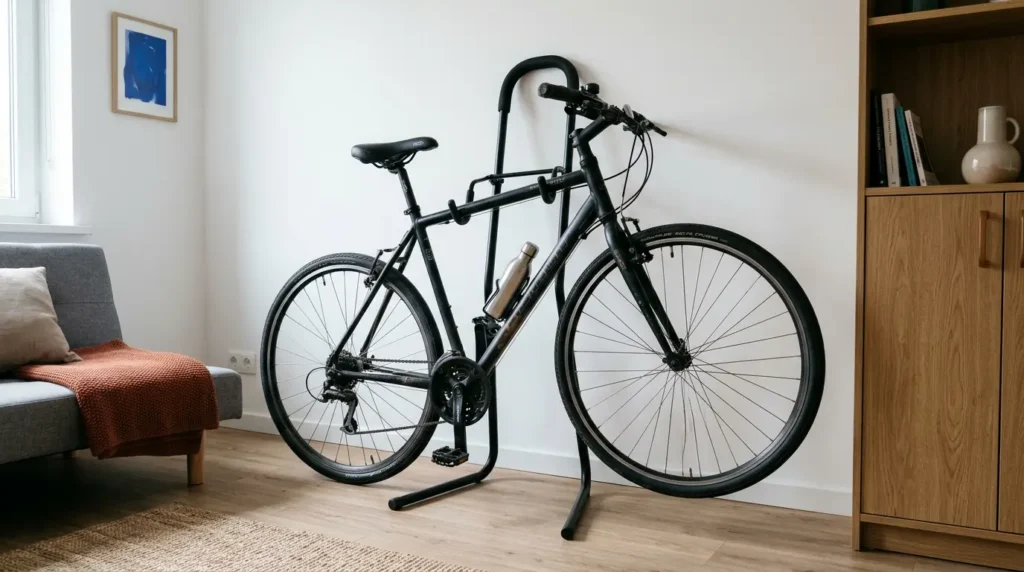
Not every apartment has room for a pole, and not every renter wants one more thing mounted overhead. A gravity stand solves the same problem by leaning the bike instead.
Look for a stand with wide base plates and padded contact points where the frame touches the wall. Lift only the front wheel into the stand and let the rest of the bike lean back. Set the handlebars at an angle so the brake levers clear the wall instead of pressing into it, and add felt pads under the base if you have wood floors.
There is no drilling and no adhesive involved, which makes this one of the easiest apartment bike storage ideas to undo at move-out. Cost runs low to mid range depending on the brand. The one place this fails is with a heavy e-bike on a narrow stand rated for lighter frames, so always check the stand’s rated weight against your actual bike before buying.
4. A Freestanding A-Frame For Daily Riders
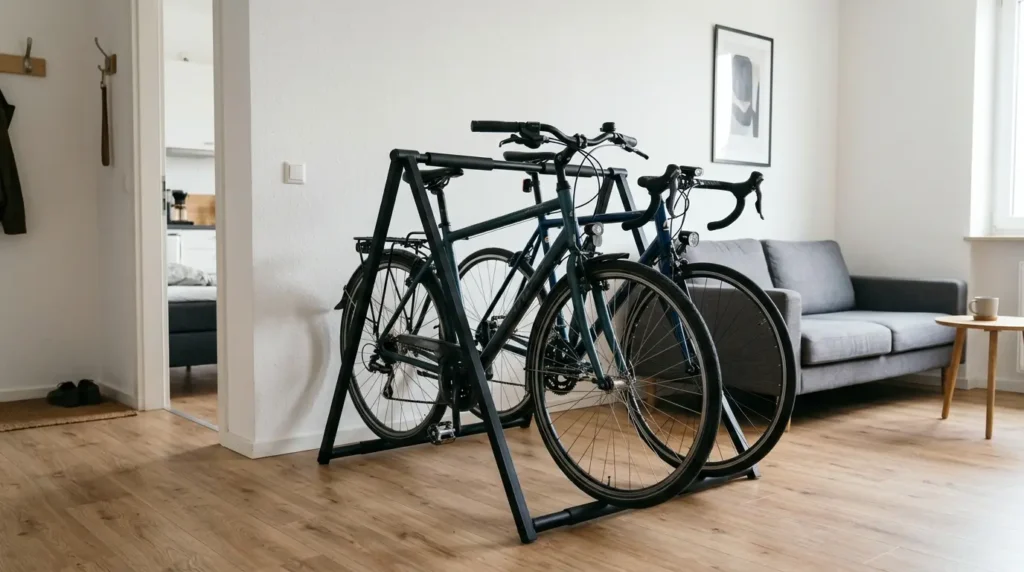
If you ride every single day, a stand that takes two minutes to load is a stand you will eventually stop using. An A-frame fixes that by being fast.
These stands use a steel or hardwood frame with wide feet for stability and adjustable arms sized to your tire width. You roll the bike in and out without lifting or hooking anything, which matters most on mornings when you are already running late. Set it against a wall out of the main walking path, not in the center of the room.
Cost is in the mid range for most frames. Since it sits entirely on the floor, there is nothing to patch when you move. Avoid a narrow frame that tips when the bike is off balance, and skip any frame without rubber pads on the feet, since bare metal on a wood floor scratches fast. Of all the apartment bike storage ideas on this list, this one trades a larger footprint for the fastest daily use, which is worth it if you ride most days.
5. A Rolling Stand You Can Move To Clean

Dirt collects fast under a bike that never moves, and a studio floor shows it quickly. A rolling stand is built to get out of the way.
These stands sit on a low wheeled base with locking casters. Park the bike centered on the base, set the brakes, and lock the casters so it cannot drift. A front wheel chock keeps the tire from sliding sideways. When it is time to clean, unlock the casters and roll the whole setup aside, then roll it back into place.
As one reference point, a typical rolling vertical stand fits wheels up to 29 inches and tires up to 4 inches wide, and supports around 55 pounds, so always check those numbers against your own bike before you buy. Cost is mid range. There is no drilling and no wall contact at all. The main thing to avoid is leaving the casters unlocked in a narrow hallway, where a bike on wheels can roll into a doorway on its own.
Pro Tip:
A short strip of felt tape under each caster’s resting spot protects hardwood and laminate floors from scuffing over time.
6. A Vertical Floor Stand For One Bike In A Corner
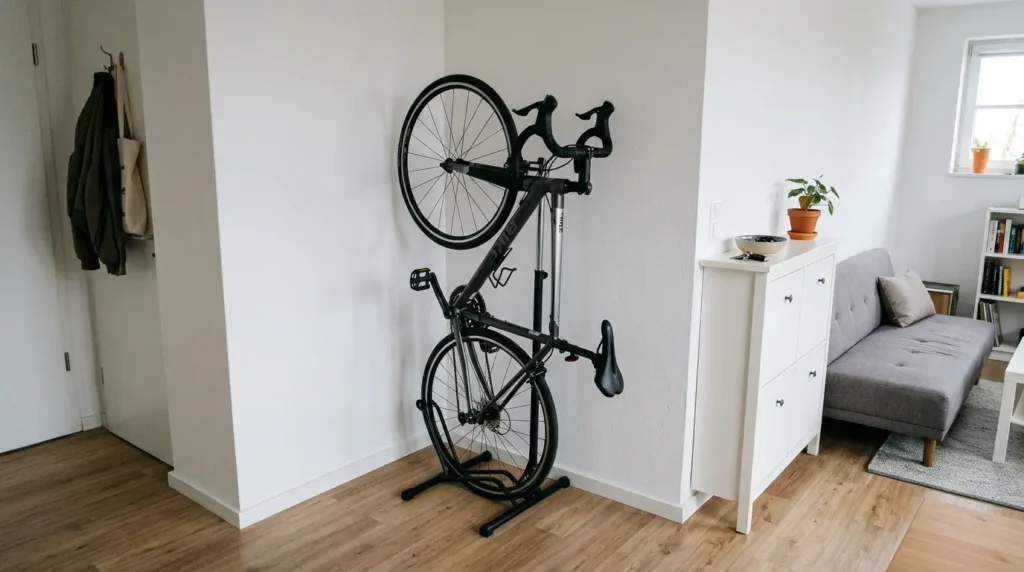
A single bike in a dead corner is one of the simplest apartment bike storage ideas to set up, and it needs almost no planning.
The front wheel slots into the stand while the frame stands upright, so the bike takes up a corner footprint instead of its full length. Before buying, measure your wheel size, tire width, bike weight, and the width of your handlebars when the bike is standing upright, since a wide handlebar can stick further into the room than you expect.
Cost is low, one stand. It sits entirely on the floor, so a renter never has to patch anything. Skip this option if the bike is heavier than you can comfortably lift, since loading the front wheel into the stand takes a small lift every time. This is also a solid starting point if you are testing apartment bike storage ideas for the first time and do not want to commit to a bigger setup yet.
7. Shrink The Bike Before You Park It

Sometimes the problem is not length, it is width. A bike with handlebars turned sideways eats up far more wall space than one folded flat.
Rotate the handlebars so they line up with the frame instead of sticking out, remove one pedal with the right wrench, and lower the seat. With those three changes, the bike sits noticeably flatter against a wall pad. Handlebars typically run 38 to 80 centimeters wide, and pedals stick out another 6 to 10 centimeters per side, so this small adjustment can save real inches in a tight studio.
This costs nothing if you already own basic tools. Nothing touches the wall except a soft pad, so there is nothing for a landlord to notice. Avoid forcing a pedal off with the wrong tool, since you can strip the threads, and never leave a loose pedal sitting on the floor where you will step on it later. This method is best for a seasonal or second bike. Doing it every single day gets old fast.
8. Furniture-Style Apartment Bike Storage Ideas
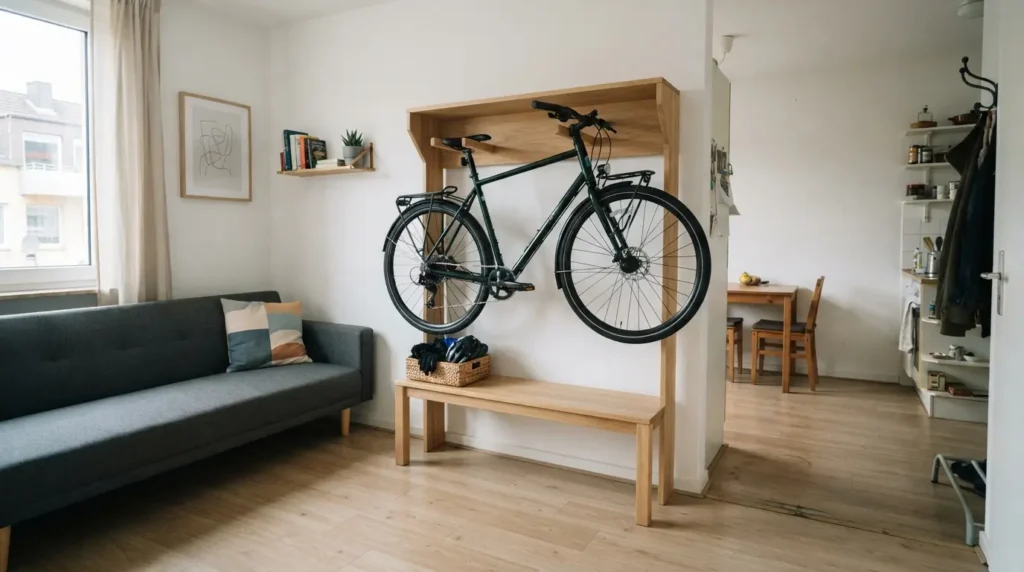
A bike in the living room can look like clutter, or it can look like it belongs there. The difference is whether it is treated like a piece of furniture.
A bike shelf with helmet and key hooks built in turns the bike into part of the room’s layout. A bench cabinet with a hidden steel frame and vents for an e-bike battery hides the bike entirely while doubling as seating. A low console that cradles the top tube works well against a shorter wall. Wire grid cubes set into a shallow bay are another option, with the bike held by a front wheel chock, helmets and locks on the upper shelf, and chargers kept low.
These pieces cost more than a simple stand, but they stay floor standing with no wall fixing required, so a renter check is easy to pass. Among furniture-style apartment bike storage ideas, the one trap to avoid is choosing a piece that looks great in photos but is awkward to actually load a bike into every day. Usability should win over looks.
9. An Indoor Bike Cover For Living Room Parking

A bike parked in a living room collects dust, leaves tire marks, and can look messy fast, even with a good stand underneath it.
A cover solves the look, not the storage, so pair it with one of the stands above rather than using it alone. Wipe the tires on a mat before you cover the bike, then slip the cover on and tuck the hem underneath so it cannot slide off. Choose a breathable cover rather than a solid plastic one, since plastic traps moisture against the frame and can lead to rust over time.
Cost is low, one cover. There is no install at all, so it leaves no marks. The main mistake is buying a cover too small for the bike, since a tight cover tends to pull the whole setup off its stand when you walk past it.
Leave a small gap at the bottom hem of the cover so air can move through, rather than sealing it tight against the floor.
10. Seasonal Storage For The Second Bike

A second bike, or a bike you only ride in one season, should not be sitting in your main daily spot taking up prime real estate.
Flat under-bed storage works for a bike with the wheels removed. For something more protected, a closet bay with a freestanding vertical cradle behind a standard interior door is a strong option. Angle the arms so the handlebars clear the door frame, add a doorstop to protect the brake levers, and consider a small LED strip and a drip tray underneath. Store wheels and loose gear in a tote nearby.
Cost runs low to mid range. Nothing is drilled, so the closet returns to normal the day you move out. Avoid hanging a seasonal bike directly over your daily walking path, and skip a ceiling hoist entirely if you ride that bike daily, since lowering and raising it every day gets old within a week. Among apartment bike storage ideas for a second bike, a closet bay tends to hold up better long term than under-bed storage, simply because it is easier to get to.
11. A Balcony Bike Corner, If Your Lease Allows It

When indoor space runs out but the balcony sits empty, it is tempting to move the bike outside. Balcony apartment bike storage ideas work only if the lease allows them, so check first, then build the corner.
If it is allowed, use a breathable, waterproof cover secured tightly at the hem, paired with a freestanding stand that has wide feet and a rubber mat underneath. Turn the pedals inward so they do not catch on anyone walking past, and keep the bike below railing height where possible. Tie points should attach to the stand itself, never to the railing. A slim wind screen or a row of planters can block the bike from street view without looking out of place.
Cost is low to mid range for the cover and stand. For the renter check, confirm weight limits, visibility rules, and fire safety requirements with your building, and get anything unclear in writing before you move a bike out there. Avoid blocking the balcony door, and never store a bike uncovered through rain, salt air, or heavy dust.
12. E-Bike Charging Off The Exit Path
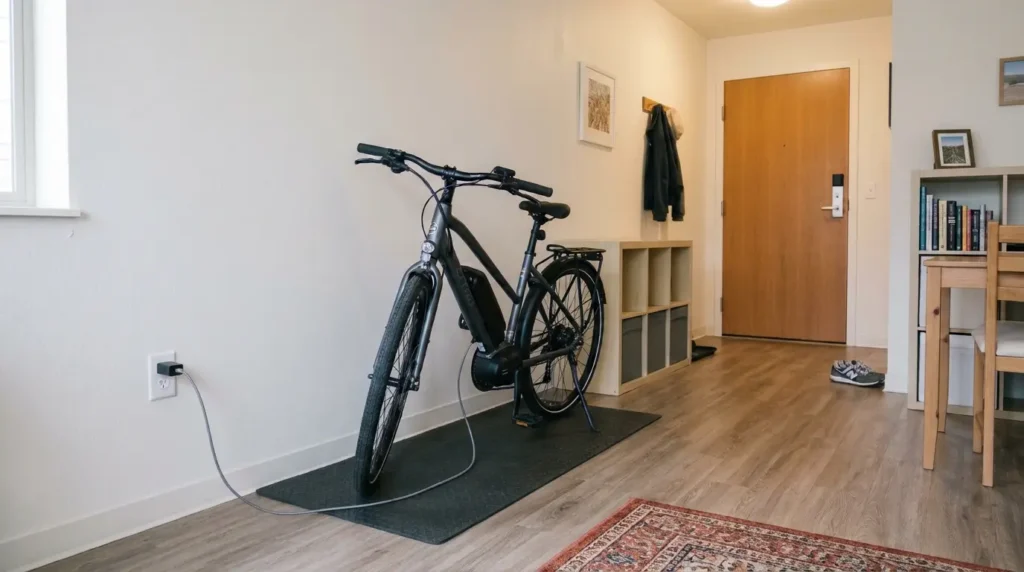
An e-bike changes the math. The extra weight and the battery both need their own plan, separate from where the bike simply parks.
Choose a rack rated well above the bike’s actual mass, and check that the heavier front end is supported, not just the rear wheel. Set up a charging spot on a side wall, away from the door you would use to leave in an emergency, and remove the battery for charging if the bike allows it. Keep the charger low and route the cord so it never crosses your walking path.
On safety, keep it simple. Charge only when you are home and awake, use the factory charger or a certified equivalent, and place it on a non-flammable surface like tile or a metal tray, away from exits and anything soft like bedding or curtains. Let the battery cool down after a ride before you plug it in, and check it now and then for any swelling. Cost is low, usually just one tray and one wall spot. Avoid charging overnight while you are asleep, charging unattended, or charging on a soft surface like a rug.
Pro Tip:
Place or check a smoke detector within a few feet of the e-bike charging spot, not just the one already mounted across the room.
13. Anti-Theft Layers That Do Not Damage The Lease
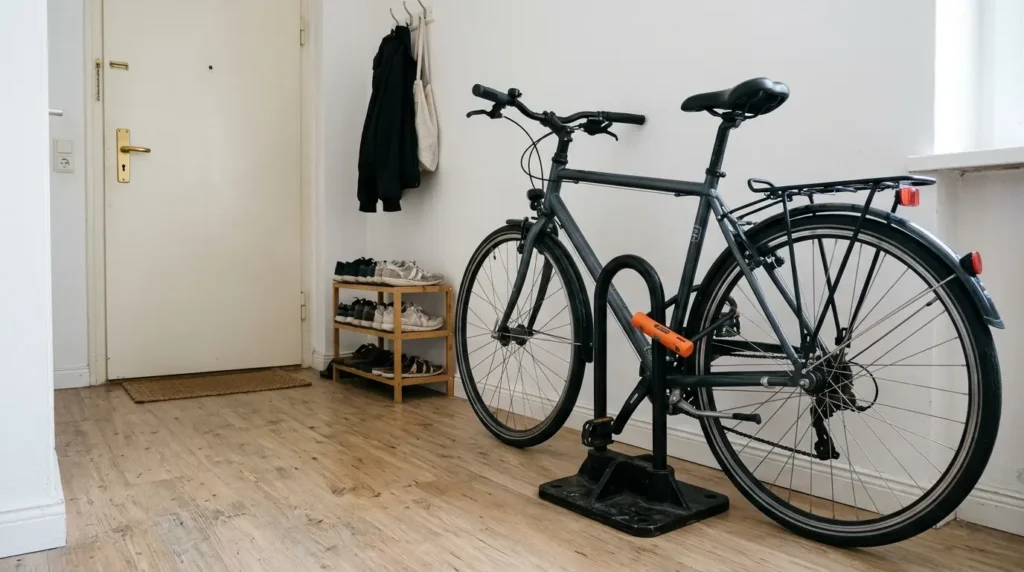
A bike visible from a street-facing window is still a target, even three floors up, so the storage spot you choose should also work as a layer of protection.
Lock the frame itself, not just a wheel, and run the lock through a secure point on the stand rather than just around a railing. Add a small chain for the rear wheel if your hubs allow it. Keep the stand away from windows, and close curtains when the bike is visible from outside.
A small hidden tracker tucked into a seatpost, handlebar, or light adds another layer. Record your frame’s serial number, keep digital copies of your receipts, and photograph the bike along with any accessories. If you have an e-bike, remove the battery whenever you are away for more than a few hours and store it in a ventilated bin.
Cost stays low to mid range for a chain and a tracker. Nothing here involves drilling or adhesive. Avoid leaving tools, chargers, or spare batteries sitting out in plain sight near a window, since that alone can draw attention to the bike.
Pro Tip:
Pair a U-lock on the frame with a cable lock through the wheel, rather than two locks of the same type, since that forces a thief to carry two different sets of tools.
What Not To Buy
A few products show up again and again in apartment bike storage ideas, and most of them cause more problems than they solve for a renter. Skip drilled J-hooks and any wall mount that needs a stud, since most studio walls cannot support one safely and the holes are hard to hide later. Skip ceiling hoists if you ride daily, since lowering a bike by rope every morning gets old fast.
Skip any stand rated below your bike’s actual weight, especially for an e-bike, and skip wall racks bought without checking your tire width, frame shape, wheel size, and fender clearance first. Finally, skip racks that photograph beautifully but are awkward to actually load.
Decision Guide
Not every studio needs the same apartment bike storage ideas, so use this as a quick filter before you read the systems above in detail. If you ride every day, choose an A-frame or a rolling stand parked right by the door. If you ride once or twice a week, a gravity stand or a vertical floor stand in a corner is enough. With two bikes, a tension pole works well, as long as the heavier bike sits on the lower arm.
With an e-bike, choose a low, heavy-rated floor stand and set up charging on a side wall, off the exit path. If your lease allows a balcony, a covered balcony corner frees up indoor space entirely. If you have almost no floor space at all, shrink the bike first, then store it in a vertical cradle behind a door. Most people land on two of these apartment bike storage ideas at once, one for daily parking and one for a second or seasonal bike.
Measurements Table
These are the numbers that come up across nearly every one of the apartment bike storage ideas above, so take them before you shop.
| What to measure | Target |
| Bike weight | Check against your stand’s rated capacity |
| Handlebar width | 38 to 80 centimeters |
| Pedal width | 6 to 10 centimeters per side |
| Ceiling height | Measure twice, include carpet pile |
| Bed to door path | At least 30 inches clear |
| Corner footprint and door swing | Measure before buying any stand |
Landlord Audit Checklist
A lot of apartment bike storage ideas fail not because the stand is wrong, but because nobody checked the lease first. Read your lease before you buy anything. Photograph the space you plan to use, then send your landlord a short plan that names the product, its footprint, and how you will protect the surface.
Use felt pads under every foot of the stand, rubber mats under the wheels, and foam sleeves on any contact point against a wall. If the lease is unclear, get written approval and keep it with your lease documents. At move-out, remove the stand, check that no caps or pads left marks, and clean the mat area one last time.
Copyable Summary Checklist
Save or screenshot this list of apartment bike storage ideas distilled into one routine. Park the bike by the door. Keep the handlebars parallel to the wall. Keep the path clear. Measure before you buy anything. Choose a rack rated above your bike’s weight. Use a mat, a bin, and a towel hook. Charge an e-bike only when you are home and awake, on tile or a metal tray, off the exit path. Lock the frame, add a tracker, and record your serial numbers. Clean the area weekly. Recheck pole torque after the first day. Move the stand aside to mop underneath it.
Conclusion
A studio apartment does not need to feel like a bike shop. With the right apartment bike storage ideas, a bike can have one fixed spot by the door, a rated rack or stand that actually fits it, a mat to catch the dirt, and an e-bike charging setup that stays off your exit path. Once that system is in place, riding stops being a daily negotiation with your floor space, and the room goes back to feeling like an apartment instead of a garage.
Frequently Asked Questions
For more ways to make a small space work harder, see our studio apartment organization ideas at https://studiolivingguide.com/studio-apartment-organization-ideas/ and renter-friendly room dividers at https://studiolivingguide.com/renter-friendly-room-dividers/. Landlords usually treat a freestanding rack as furniture rather than a fixture at https://theownerbuildernetwork.co/apartment-bike-storage/, which matters when it is time to get your deposit back.
Browse all our Organization & Storage at https://studiolivingguide.com/c/studio-apartment-organization/